
ISO and ANSI UAV system standardization work and results
1.ISO’s UAV system standardization work and results
Organization structure and main responsibilities
ISO/TC 20/SC 16 (International Organization for Standardization Aerospace Technical Committee Subcommittee on Unmanned Aircraft Systems) is a technical subcommittee (SC) of the ISO International Organization for Standardization specializing in standardization in the field of unmanned aerial systems (UAS). The secretariat is ANSI in the United States. The technical subcommittee was established in June 2015 and currently has 27 member organizations and 10 observer organizations.
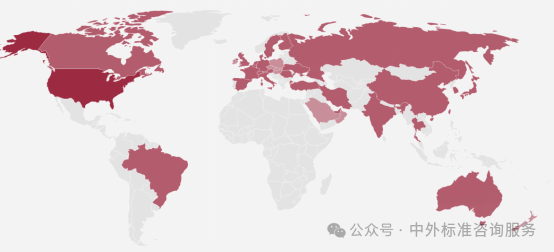
Distribution map of ISO member and observer organizations
SN |
member organization |
||
1 |
Australia |
SA |
Standards Australia |
2 |
Austria |
ASI |
Austrian Standards Institute |
3 |
Belgium |
NBN |
Belgian Standards Institute |
4 |
Brazil |
ABNT |
Brazilian Standards Institute |
5 |
Canada |
SCC |
Canadian Standards Council |
6 |
China |
SAC |
China National Standardization Administration Committee |
7 |
Denmark |
DS |
Danish Standards Institute |
8 |
Finland |
SFS |
Finnish Standards Institute |
9 |
France |
AFNOR |
french standardization association |
10 |
Germany |
DIN |
german institute for standardization |
11 |
India |
BIS |
Bureau of Indian Standards |
12 |
Iran |
INSO |
iranian national standards organization |
13 |
Italy |
UNI |
Italian Standardization Association |
14 |
Japan |
JISC |
Japan Industrial Standards Research Council |
15 |
South Korea |
KATS |
Korean Bureau of Technology and Standards |
16 |
Netherlands |
NEN |
Dutch Standards Institute |
17 |
Romania |
ASRO |
romanian standardization association |
18 |
Russia |
GOSTR |
Federal Service of Technical Regulations and Metrology of the Russian Federation |
19 |
Spain |
UNE |
spanish standardization association |
20 |
Sweden |
SIS |
Swedish Standards Institute |
twenty one |
Switzerland |
SNV |
Swiss Standardization Institute |
twenty two |
Thailand |
TISI |
Thai Industrial Standards Association |
twenty three |
Türkiye |
TSE |
Turkish Standards Institute |
twenty four |
Ukraine |
SE UkrNDNC |
Ukrainian Scientific Research and Training Center on Standardization, Certification and Quality Issues |
25 |
United Arab Emirates |
MoIAT-STR |
Directorate of Standards and Technical Regulations, Ministry of Industry and Advanced Technology, UAE |
26 |
U.K. |
BSI |
british standards institute |
27 |
USA |
ANSI |
American National Standards Institute |
SN |
observer organization |
||
1 |
Czech Republic |
UNMZ |
Czech Institute of Standards, Metrology and Testing |
2 |
Hungary |
MSZI |
Hungarian Standards Association |
3 |
Ireland |
NSAI |
Irish National Standards Authority |
4 |
Luxembourg |
ILNAS |
Luxembourg Association for the Standardization, Certification, Safety and Quality of Products and Services |
5 |
New Zealand |
NZSQ |
New Zealand Standards Organization |
6 |
Oman |
DGSM |
General Directorate of Specifications and Measurements of Oman |
7 |
Poland |
PKN |
Polish Standardization Committee |
8 |
Saudi Arabia |
SASO |
Saudi Standards, Metrology and Quality Organization |
9 |
Singapore |
SSC |
Singapore Standards Council |
10 |
Slovakia |
UNMSSR |
Slovak Agency for Standards, Metrology and Testing |
The responsibility of ISO/TC 20/SC 16 is to formulate and maintain relevant standards for unmanned aerial systems. The scope of work covers the classification, design, manufacturing, operation (including maintenance) and safety management of unmanned aerial systems, especially the Standardization work on materials, components and equipment. The scope of standards developed covers: ① standards related to unmanned aerial vehicles (UAVs), ground control stations (GCS) and radio communication links connecting them; ② services and services related to the above systems Maintain standards related to the equipment used; ③Operation standards for UAV systems.
The secretariat of ISO/TC 20/SC 16 is responsible for administrative tasks, such as organizing meetings, distributing documents and maintaining the subcommittee website; the chairman is responsible for leading the subcommittee, setting the agenda and ensuring the smooth functioning of the committee; representatives of organizations from ISO member countries participate in the subcommittee Committee, each country has a voting representative; the sub-committee meets regularly, usually twice a year, to discuss ongoing projects and new proposals of each working group, vote on draft standards, and the standards that pass the vote will become a formal international standard. standard.
Working Groups: ISO/TC 20/SC 16 has 1 Chairman’s Advisory Group (CAG); 1 Advisory Group (AG) responsible for UAV system autonomy supported by AI technology; 8 Working Groups (WG) and Joint working groups (JWG), responsible for general (WG1), product manufacturing and maintenance (WG2), operations and procedures (WG3), UAS traffic management (WG4), test and evaluation (WG5), UAS Subsystem (WG6), UAV system noise measurement (JWG7), anti-UAV system (WG8), etc.
Standardization achievements
SN |
Standard English name |
1 |
ISO 4358:2023 - Test methods for civil multi-copter unmanned aircraft system |
2 |
ISO 5015-2:2022 - Unmanned aircraft systems - Part 2: Operation of vertiports for vertical take-off and landing (VTOL) unmanned aircraft (UA) |
3 |
ISO 5109:2023 - Evaluation method for the resonance frequency of the multi-copter UA (unmanned aircraft) by measurement of rotor and body frequencies |
4 |
ISO 5110:2023 - Test method for flight stability of a multi-copter unmanned aircraft system (UAS) under wind and rain conditions |
5 |
ISO 5286:2023 - Flight performance of civil small and light fixed-wing unmanned aircraft systems (UAS) - Test methods |
6 |
ISO 5305:2024 - Noise measurements for UAS (unmanned aircraft systems) |
7 |
ISO 5309:2023 - Civil small and light unmanned aircraft systems (UAS) Vibration test methods |
8 |
ISO 21384-2:2021 - Unmanned aircraft systems Part 2: UAS components |
9 |
ISO 21384-3:2023 - Unmanned aircraft systems—Part 3: Operational procedures |
10 |
ISO 21384-4:2020 - Unmanned aircraft systems - Part 4: Vocabulary |
11 |
ISO 21895:2020 - Categorization and classification of civil unmanned aircraft systems |
12 |
ISO/TR 23267:2024 - Experiment results on test methods for detection and avoidance (DAA) systems for unmanned aircraft systems |
13 |
ISO/TR 23629-1:2020 - UAS traffic management (UTM) —Part 1: Survey results on UTM |
14 |
ISO 23629-5:2023 - UAS traffic management (UTM) --Part 5: UTM functional structure |
15 |
ISO 23629-7:2021 - UAS traffic management (UTM) -- Part 7: Data model for spatial data |
16 |
ISO 23629-8:2023 - UAS traffic management (UTM) -Part 8: Remote identification |
17 |
ISO 23629-9:2023 - UAS traffic management (UTM) Part 9: Interface between UTM service providers and users |
18 |
ISO 23629-12:2022 - UAS traffic management (UTM) - Part 12: Requirements for UTM service providers |
19 |
ISO 23665:2023 - Unmanned aircraft systems—Training for personnel involved in UAS operations |
20 |
ISO 24352:2023 - Technical requirements for small unmanned aircraft electric energy systems |
twenty one |
ISO 24354:2023 - General requirements for the payload interface of civil unmanned aircraft systems |
twenty two |
ISO 24355:2023 - Flight control system for civil small and light multicopter unmanned aircraft system (UAS) - General requirements |
twenty three |
ISO 24356:2022 - General requirements for tethered unmanned aircraft systems |
Currently, there are 25 UAV standards published by ISO/TC 20/SC 16 (see table below), and another 11 standards are under development. The published standards mainly involve test methods for civil multi-rotor UAV systems, operation of vertical take-off and landing UAVs, multi-rotor UAV resonance frequency evaluation, flight stability testing, and flight performance of small and lightweight fixed-wing UAVs. Testing, noise measurement of UAV systems, vibration testing, UAV system components, operating procedures, terminology, classification, detection and avoidance system experimental results, functional structure of UAV traffic management (UTM), data model, remote identification , interface between UTM service provider and user, UTM service provider requirements, UAV system personnel training, technical requirements for small UAV electric energy system, general requirements for UAV system payload interface, multi-rotor unmanned aerial vehicle General requirements for aircraft flight control systems and general requirements for tethered UAV systems.
Tips
According to the naming rules of the ISO organization, ISO/TC 20/SC 16 refers to the 16th Subcommittee (SC) of the 20th Technical Committee (TC) under the ISO International Organization for Standardization, focusing on unmanned aerial systems (UAV systems) UAS) standardization work.
2.ANSI’s UAV system standardization organization work and results
Organization structure and main responsibilities
The American National Standards Institute ANSI is the secretariat of ISO/TC 20/SC 16 and has done a lot of work in promoting the development of UAV system standards within the ISO organization. In addition, ANSI coordinates and promotes domestic UAV system standardization work in the United States through its UAV System Standardization Cooperation (UASSC).
UASSC has more than 400 members from 250 public and private sectors in the United States, including representatives from the Federal Aviation Administration (FAA), other U.S. federal government agencies, standards development organizations (SDOs), industry, academia, and other organizations . To develop the roadmap, UASSC established four working groups (WG), which usually hold online meetings twice a month: WG1 is responsible for airworthiness; WG2 is responsible for general flight operations, personnel training, qualification and certification; WG3 is responsible for key Flight operations for infrastructure inspections, environmental applications, commercial services and workplace safety; WG4 is responsible for flight operations for public safety.
In December 2018, UASSC released version 1.0 of the "Unmanned Aircraft System Standardization Roadmap"; in June 2020, version 2.0 of the "Roadmap" was released. By publishing the Roadmap, UASSC identifies existing standards and those under development related to unmanned aerial systems, defines where gaps exist, and makes recommendations on priority areas deemed to require additional standardization, including pre-standardization research and development ( R&D) work.
The main areas covered in the Roadmap are: drone airworthiness; flight operations; personnel training, qualification and certification; infrastructure inspections; environmental applications; commercial services; workplace safety; and public safety operations. The Roadmap also provides a brief overview of UAS activities at the FAA, other U.S. federal government agencies, standards development organizations (SDOs), and various industry groups. Compared with version 1.0, version 2.0 has been significantly revised or expanded to include the following areas: spectrum categories applicable to command and control (C2) links and communications, continued operations security, unmanned aerial system detection and mitigation, and public safety tactical operations .
In addition, UASSC also tracks and records the progress of unmanned system standardization work by regularly publishing the Gap Progress Report. The latest version of the Gap Progress Report will be released in March 2024, and the next version of the Gap Progress Report will be released in September 2024.
Standardization achievements
SN |
Standard English name |
1 |
SAE ARP5707-2010 - Pilot Training Recommendations for Unmanned Aircraft Systems (UAS) Civil Operations |
2 |
SAE ARP94910-2012 - Aerospace-Vehicle Management Systems-Flight Control Design, Installation, and Test of Military Unmanned Aircraft |
3 |
SAE ARP6336-2019 - Lighting Applications for Unmanned Aircraft Systems (UAs) |
4 |
CTA2063-2017 (ANSI) - Small Unmanned Aerial Systems Serial Numbers |
5 |
ASTM E2521-16 - Standard Terminology for Evaluating Response Robot Capabilities |
6 |
ASTM F2849-10 (2019) - Standard Practice for Handling of Unmanned Aircraft Systems at Divert Airfields |
7 |
ASTM F2851-10 (2018) - Standard Practice for UAs Registration and Marking (Excluding Small Unmanned Aircraft Systems) |
8 |
ASTM F2908-18 - Standard Specification for Unmanned Aircraft Flight Manual (UFM) for an Unmanned Aircraft System (UAS) |
9 |
ASTM F2909-19 - Standard Specification for Continued Airworthiness of Lightweight Unmanned Aircraft Systems |
10 |
ASTM F2910-14 - Standard Specification for Design and Construction of a Small Unmanned Aircraft System (SUAS) |
11 |
ASTM F2911-14e1 - Standard Practice for Production Acceptance of Small Unmanned Aircraft System (SUAS) |
12 |
ASTM F3002-14a - Standard Specification for Design of the Command and Control System for Small Unmanned Aircraft Systems (SUAS) |
13 |
ASTM F3003-14 - Standard Specification for Quality Assurance of a Small Unmanned Aircraft System (SUAS) |
14 |
ASTM F3005-14a - Standard Specification for Batteries for Use in Small Unmanned Aircraft Systems (sUAs) |
15 |
ASTM F3178-16 - Standard Practice for Operational Risk Assessment of Small Unmanned Aircraft Systems (SUAS) |
16 |
ASTM F3196-18 - Standard Practice for Seeking Approval for Beyond Visual Line of Sight (BVLOS) Small Unmanned Aircraft System (SUAS) Operations |
17 |
ASTM F3201-16 - Standard Practice for Ensuring Dependability of Software Used in Unmanned Aircraft Systems (UAS) |
18 |
ASTM F3262-17 - Standard Classification System for Small Unmanned Aircraft Systems (SUASs) for Land Search and Rescue |
19 |
ASTM F3266-18 - Standard Guide for Training for Remote Pilot in Command of Unmanned Aircraft Systems (UAS) Endorsement |
20 |
ASTM F3269-17 - Standard Practice for Methods to Safely Bound Flight Behavior of Unmanned Aircraft Systems Containing Complex Functions |
twenty one |
ASTM F3298-19 - Standard Specification for Design, Construction, and Verification of Lightweight Unmanned Aircraft Systems (UAS) |
twenty two |
ASTM F3322-18 - Standard Specification for Small Unmanned Aircraft System (SUAS) Parachutes |
twenty three |
ASTM F3330-18 - Standard Specification for Training and the Development of Training Manuals for the UAS Operator |
Up to now, under the coordination of UASSC, various domestic standards development organizations (SDOs) in the United States have developed and released a series of standards related to UAV systems, covering multiple aspects of UAV systems (see table below). Specifically include: pilot training, flight control design, lighting applications, serial numbers, terminology, handling procedures, registration and marking, flight manual, continued airworthiness, design and construction, production acceptance, command and control system design, quality assurance, batteries , operational risk assessment, beyond line of sight operations, software reliability, classification systems, training guides, flight behavior limitation methods, design construction and verification, parachutes, and training manual development, etc.
Preview of next issue sharing
"Service Center Research Results Display"
- stay tuned-
- Previous : Harness the new era of AI and create a smart future - ISO/IEC 42001:2023 standard helps companies build efficient artificial intelligence management systems!
- Next : American Association of State Highway and Transportation Officials (AASHTO) - a complete transportation engineering standards system


