
The Railway Engineer's Essential Guide! How do AREMA standards impact global railway construction?
American Railway Engineering and Maintenance-of-Way Association, the full English name is American Railway Engineering and Maintenance-of-Way Association, referred to as AREMA. It was founded in 1997 by the merger of four railway engineering organizations. It is an authoritative organization in the field of railway engineering in the United States. It has been It has developed into one of the most influential professional organizations in the global railway industry. AREMA focuses on technical research, standard setting and maintenance technology promotion of railway engineering, and is committed to promoting the safety, efficiency and sustainable development of the railway industry. The association’s members include railway companies, engineers, equipment manufacturers, contractors, consulting companies, academic institutions and other railway-related professionals, and are committed to promoting the sustainable development and innovation of railway infrastructure.
01
mission and goals
AREMA's core mission is to provide technical support for the construction, operation and maintenance of railway infrastructure through the development and promotion of industry standards. Its goal is to improve the safety, reliability and efficiency of railway engineering around the world, while promoting technological advancement and innovation in railway systems. Through technical exchanges among members, promotion of standardization work and research on railway engineering technology, AREMA provides the industry with extensive knowledge resources and training support.
02
organizational structure
AREMA has multiple technical committees responsible for standard formulation and technical research in different fields. These committees are composed of experts from the railway industry and cover all aspects of railway engineering, including tracks, bridges, tunnels, signaling systems, electrification, communications, environmental protection and other fields. Each committee develops and updates corresponding technical standards through regular discussions, research and practice to ensure the advancement and practicality of railway engineering technology.
03
AREMA publications and training
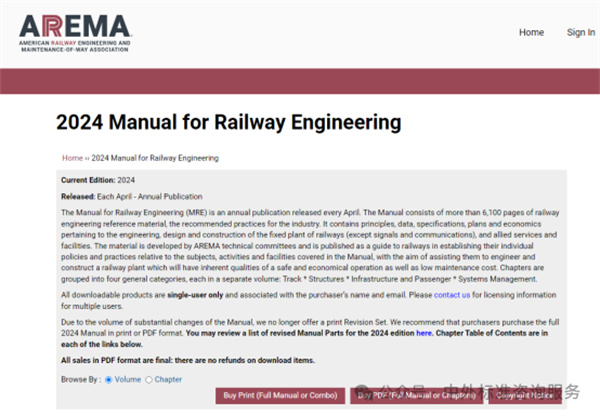
In addition to the development of standards, AREMA also disseminates railway engineering knowledge through the publication of technical manuals, reports and journals. Its main publication, AREMA Manual for Railway Engineering, is recognized as an authoritative reference book in the field of railway engineering, covering detailed technical specifications for tracks, bridges, tunnels, etc.
The AREMA Railway Engineering Manual mainly relates to relevant standards for the engineering design and construction of railway fixtures or equipment (excluding signaling and communication engineering equipment) and service facilities. The content of this manual is used as a guideline and recommended measures, mainly used to establish independent policies and measures for railways. In this manual, some railway-related theme activities and related facilities are involved. The purpose of providing these contents is It assists engineers in the normal construction of railway equipment, and also ensures that railway equipment meets inherent safety and quality requirements and can operate economically under low-cost conditions.
The AREMA manual is not just a maintenance manual. This manual consistently develops relevant standards or specifications for the maintenance of railway pavements, tracks and their structures. In particular, this manual develops relevant standards based on the nature and characteristics of railway equipment and these equipment characteristics are related to the geography through which the railway passes. related to the characteristics of the region.
The above description also applies to the AREMA Orbital Planning Document, which is a subsidiary volume of the AREMA Manual. The plans involved in this document are related to the design, details, materials and processes of railway frogs, switches, intersections and other special tracks, and these plans will be reviewed by the Track Professional Group of the 5th Committee of the Association. Formulation and implementation, including the formulation and implementation of relevant chapters of this manual.
AREMA Railway Engineering Manual Table of Contents 2024 Edition(Chinese-English bilingual)
serial number |
English name |
Chinese name |
Volume 1 Volume 1 |
||
1 |
Chapter 01 Roadway and Ballast |
Chapter 1 Roadbed and Ballast |
2 |
Chapter 04 Rail |
Chapter 4 Rails |
3 |
Chapter 05 Track |
Chapter 5 Orbit |
4 |
Chapter 30 Ties |
Chapter 30 Sleepers |
Volume 2Volume 2 |
||
5 |
Chapter 07 Timber Structures |
Chapter 7 Timber Structure |
6 |
Chapter 08 Concrete Structures and Foundations |
Chapter 8 Concrete Members and Foundations |
7 |
Chapter 09 Seismic Design for Railway Structures |
Chapter 9 Seismic Design of Railway Buildings |
8 |
Chapter 10 Structures, Maintenance and Construction |
Chapter 10 Structure, Maintenance and Construction |
9 |
Chapter 15 Steel Structures |
Chapter 15 Steel Structure |
Volume 3 Volume 3 |
||
10 |
Chapter 06 Buildings and Support Facilities |
Chapter 6 Buildings and Auxiliary Facilities |
11 |
Chapter 11 Commuter and Intercity Rail Systems |
Chapter 11 Suburban Railways and Intercity Railways |
12 |
Chapter 12 Rail Transit |
Chapter 12 Rail Transit |
13 |
Chapter 14 Yards and Terminals |
Chapter 14 Stations and hubs |
14 |
Chapter 17 High Speed Rail Systems |
Chapter 17 High Speed Rail Systems |
15 |
Chapter 18 Light Density and Short Line Railways |
Chapter 18 Low Density Short Range |
16 |
Chapter 27 Maintenance-of-Way Work Equipment |
Chapter 27 Road Maintenance Work Equipment |
17 |
Chapter 33 Electrical Energy Utilization |
Chapter 33 Electric Energy Application |
Volume 4 Volume 4 |
||
18 |
Chapter 02 Track Measurement and Assessment Systems |
Chapter 2 Orbital Measurement System |
19 |
Chapter 13 Environmental |
Chapter 13 Environment |
20 |
Chapter 16 Economics of Railway Engineering and Operations |
Chapter 16 Economic Factors in Railway Engineering and Operations |
twenty one |
Chapter 28 Clearances |
Chapter 28 Limits |
In addition, AREMA also regularly releases technical reports to share the latest industry research results and technological progress. Training is also part of AREMA workimportant part of the work. AREMA provides a wide range of training courses for industry practitioners, including on-site training, online courses and technical seminars, helping railway engineers and technicians to continuously improve their professional skills and master the latest technology and industry trends.
04
AREMA’s influence and global collaboration
Although AREMA's standards mainly serve the U.S. railway industry, with the increase in global railway construction projects, AREMA's technical specifications and standards are increasingly adopted by other countries and regions. For example, railway engineering projects in Europe, Asia and Latin America all refer to AREMA's technical standards to varying degrees, especially in railway bridge construction, track design and electrification systems.
AREMA actively participates in the exchange and promotion of global railway engineering technology through international cooperation. It maintains close cooperation with railway organizations, engineering associations and government agencies around the world to jointly promote standardization and technological innovation in the global railway industry. The International Railway Engineering Annual Conference and Technical Seminar held by AREMA every year also provides a platform for global railway engineers and experts to share experiences and discuss technological developments.
As an important technical support force in the field of railway engineering, AREMA has made important contributions to the safety, efficiency and sustainable development of the global railway industry by formulating strict technical standards, providing abundant training resources and promoting global cooperation. As railway system technology continues to evolve, AREMA will continue to play an important role in promoting railway technology innovation and standardization.
Attached table: "AREMA Publication List 2024"
Publication time |
English name |
Chinese name |
2024 |
2024 Communications & Signals Manual |
2024 edition of "Communication Signal Manual" |
2024 |
2024 Manual for Railway Engineering |
2024 edition of "Railway Engineering Manual" |
2024 |
2024 Portfolio of Trackwork Plans |
2024 edition of "Track Engineering Design Atlas" |
2019 |
Practical Guide to Railway Engineering |
A Practical Guide to Railway Engineering |
2017 |
Bridge Inspection Handbook |
"Bridge Inspection Manual" |
2024 |
Guidelines for the Design of Steel Railroad Bridges for Constructability and Fabrication |
"Steel Road and Bridge Constructability and Manufacturability Design Guide" |
Continued |
Proceedings |
"Meeting Minutes" |


