
Textual Basis for Patent Translation
Article 26 of the "Patent Law" stipulates: "To apply for a patent for an invention or a utility model, documents such as a request, a description and its abstract, and a claim shall be submitted. The request shall state the name of the invention or utility model, and the inventor shall The name of the applicant, the applicant's name or title, address, and other matters. The description shall provide a clear and complete description of the invention or utility model, subject to the ability of a person skilled in the art to realize it; when necessary, there shall be drawings. The abstract should briefly explain the technical essentials of the invention or utility model. The claims should be based on the description and clearly and briefly define the scope of patent protection. For inventions and creations completed relying on genetic resources, the applicant should state in the patent application documents The direct source and original source of genetic resources; if the applicant cannot explain the original source, it shall state the reasons.”
Taking an invention or utility model patent application as an example, the application documents that need to be submitted to the Patent Office include a request, a description, its abstract, and claims, where the description, its abstract, and claims are a description of the technical content of the invention. The request simply includes the basic information of the inventor and the applicant. If the invention-creation involves genetic resources, additional explanations or even additional attachments are required.
In addition, patent documents themselves are composed of different parts, and patent documents will produce different process documents at various stages of application and examination. When a client entrusts a patent translation task, it is expected that the undertaker is a professional in the patent field and will have a dialogue in the same business field and at a professional level. Sometimes a commissioning instruction is just an application number and translation language pair without even providing any documents to be translated. Therefore, as a professional patent translator, it is necessary to clearly understand which parts of which documents need to be translated in the current translation stage, and specifically pay attention to the following aspects:
1) What content in the patent publication specification needs to be translated.
2) Are there accompanying attachments that need to be translated.
3) Which of the different forms of the same content should take precedence.
4) In what format should different content be provided.
5) What different versions need to be submitted at the same time.
6) How should different versions be related.
The following will introduce the confirmation of translated texts from different aspects, and the answers to the above questions will also be found in the following chapters.
1. Components of the patent specification
The patent specification (specification) published by various patent organizations around the world usually includes the title page, claims, specification (text, description) and drawings (if any), and the specifications published by some patent organizations also include search reports.
(1) title page
The title page is the first page and its continuation page of the patent specification, and the basic information of the patent is published in a specific position on the title page of the specification in the form of bibliographic items according to certain rules.
The bibliographic items usually include: ①Technical content information, such as the title of invention, abstract, patent classification number, etc.; ②Legal information, such as application date, inventor name, priority data, etc.; ③Document form information, such as document type, published document name of the institution, etc. Since 1973, the patent documents published by the patent offices of various countries have begun to mark the INID code (Internationally agreed Numbers for the Identification of (bibliographic) Data) stipulated by the WIPO Paris Union Patent Office International Cooperation Committee for Information Retrieval (ICI-REPAT). Indicated by two digits enclosed in circles or brackets.
The bibliographic items are represented by INID codes, and the basic bibliographic items on the title page are shown in the table below.
Example of Bibliographic Items in Table Patent Documents
Bibliographic items of patent documents
(10) Identification of patent documents |
(58) Search field |
(12) Patent file name |
(62) Divisional original application data |
(15) Correction information of patent documents |
(65) Publication data of the same application |
(19) The name of the office or organization that published or announced the patent document |
(66) National priority data |
(21) Application number |
(71) Applicant's name and address |
(22) Application date |
(72) Name of inventor |
(30) Priority data |
(73) Name and address of the patentee |
(43) Application announcement date |
(74) Agency name or agent name |
(45) Authorization Announcement Date |
(75) Name of inventor and applicant |
(48)Correct the publication date of the document |
(81) Designated countries under the PCT |
(51) International Patent Classification Number |
(84) Contracting States under the Regional Patent Treaty |
(54) Names of inventions and creations |
(85) PCT international application enters the national phase day |
(56) Prior Art Documents |
(86) Application data of PCT international application |
(57)Summary |
(87) Publication data of PCT international applications |
Among them, the abstract is an overview of the technical content of the specification. Countries usually limit the number of words in the abstract to no more than 250 words, and China’s regulations are within 300 words; the drawings of the abstract are taken from the drawings of the description, and are usually the one that can better demonstrate the main technical features of the technical solution of the invention.
The examples in the figure below show published descriptions of PCT international applications filed in Chinese and English respectively. From the title page of the published description of the PCT patent application, compared with the provisions of the Patent Law on the content of the "Request", it is easy to see that except for the abstract and abstract drawings, other information on the title page is basically the information required by the "Request". , usually directly provided or prepared by the inventor.
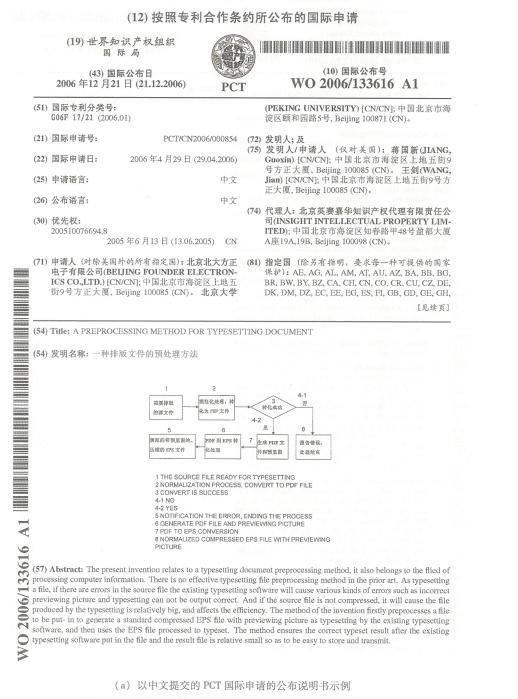
Figure Publication instructions for PCT international applications filed in Chinese and English
(2) Search report
As a process of the PCT international stage, the international search authority will search the PCT patent application and make an international search report. According to Article 26 of the Patent Law, the international search report is not one of the necessary patent application documents.
(3) "Five Patents"
In the patent application stage, the parts of the application documents that need to be translated by patent translators are the "five patent documents", namely the description, claims, abstract, drawings of the description and drawings of the abstract.
In order to meet the requirements of patent laws and regulations, the drafting of patent documents is relatively standardized. In particular, the content of the text, that is, the specification (technical field, background technology, content of the invention, description of the drawings, specific implementation methods), claims, and abstract, all have their own writing routines, and at the same time, they are logically and content-related to each other. . Fully understand this standardization and relevance, adopt the appropriate translation sequence, carry out translation from shallow to deep, from the whole to the details, and can always follow the logic of the text during the translation process, greatly reducing the need for repeated searches and revisions. Inaccurate understanding, inconsistent translation and waste of time.
Different translators may form their own unique translation habits during the translation process, and patent documents in different fields often adopt different expression styles due to different description and argumentation methods, thus suggesting different translation sequences.
Generally speaking, as far as the various components of the patent application documents are concerned, there are the following logical connections and textual features:
1) The abstract corresponds to the independent claim.
2) The title of the invention and the technical field are generally reflections of the subject matter of the independent claims.
3) The summary of the invention is a general description of all the claims, but the format often lacks the paragraph level in the claims and appears as a whole sentence or a whole paragraph.
4) The description of the drawings and the specific implementation method are specific descriptions of the invention, that is, the subject matter of the claims. However, for electromechanical patent documents that require translators to understand the invention in conjunction with the drawings, it is often necessary to read the drawings according to the description of the drawings. , a fuller understanding of the claimed subject matter can be gained after analyzing at least one embodiment in conjunction with the figures.
5) The background part is a foreshadowing of the invention, and the text is relatively simple and easy to understand, so it can be translated or read first.
To sum up, the recommended translation order is: background technology - description of drawings - one embodiment in the specific implementation mode - claims - title of invention - technical field - content of the invention - other embodiments. Translating in this order, first of all, one can fully understand the field and background of the proposed invention, know the shortcomings or unsolved problems of the related technical solutions in the prior art, know the gist of the invention of the application, and then pass the attached Figures and examples further understand the gist of the invention of the application, so as to have an overall grasp of the content of the invention. On this basis, it will be easy to translate the claims, and the content of the invention translated is often consistent with the content of the claims.
2. The published version of the patent application
Taking the PCT international application as an example, due to various factors in the examination process in the international phase, the same international application may be published in multiple different versions of the international publication specification. The international publication code of the PCT international application distinguishes the published versions of the published documents of the international application. For patents that enter the country through the international application channel, knowing the meaning of the version of the publication code can effectively identify and confirm the translation basis. According to the ST.16 standard of the World Intellectual Property Organization (WIPO), PCT international applications use the publication codes shown in the table below from January 1, 2009.
Table Examples of document codes published in PCT international applications
International Publication Code |
Announcement |
example |
Al |
The international application is published together with the international search report |
W02018/065311A1 |
A2 |
The international publication contains only the international application and lacks the international search report |
W02018/052320A2 |
A2 |
The international application is published together with the declaration under Article 17(2)(a)* |
- |
A3 |
International search report and title page to be published later |
W02018/052320A3 |
A4 |
Amended claims and declarations (Article 19** of the Treaty) and title page published later |
W02009/029171A4 |
A8 |
Corrected version of relevant bibliographic information on the title page of the international application |
W02018/065311A8 |
A9 |
Corrections, changes or supplementary documents to the international application or international search report |
W02018/154004A9 |
Note: *Article 17(2)(a) of the Patent Cooperation Treaty: If the International Searching Authority believes that: (i) the content of the international application does not require the International Searching Authority to search according to the provisions of the Regulations, and the Authority decides not to make a decision on the specific case or (ii) the description, claims or drawings do not meet the specified requirements, so that a meaningful search cannot be carried out; the above-mentioned search authority shall make a corresponding announcement and notify the applicant and the International Bureau that no international search will be carried out Report.
**PCT Article 19: Amendment of claims to the International Bureau.
The "Patent Law" clearly stipulates which version should be used as the translation basis when an international application enters the national phase. For example, Section 3.2.1, Chapter 1, Part Three of the Guidelines for Patent Examination requires: “The translation of the description and claims shall be consistent with the contents of the description and claims in the international publication text sent by the International Bureau. The translation shall be complete , and be faithful to the original text.” Section 3.2.3 also stipulates: “The abstract translation should be consistent with the content of the abstract recorded on the title page of the international publication text. For example, the international search report is not included in the international publication text A2 published for the first time, but in the In the subsequent international publication text A3, and the content of the abstract recorded on the title page of the international publication text A3 is different from that of the international publication text A2, the translation shall be based on the content of the abstract in the international publication text A3. The first publication does not include the search report. Moreover, if the abstract drawing used in the first published international publication text A2 is inconsistent with the abstract drawing used in the subsequently published international publication text A3, the abstract drawing used in the subsequent publication shall prevail."
Therefore, when the international application enters the national phase, if the applicant wishes to use the originally submitted international application as the basis for substantive examination, he needs to use the published A1 version as the basis for translation; if the application documents do not have an A1 version, the title page of the A3 version and the A2 version of the text as the basis for translation.
3. Modification of the original text of the patent application
Also taking the PCT application as an example, the applicant can make amendments to the application documents in accordance with the relevant provisions of the PCT treaty in the international phase, but must clearly indicate which amendments will be the basis for examination when proposing to enter the national phase.
The international application has two chances of revision during the international phase:
Article 19 of the PCT Treaty stipulates that the applicant has the right to submit a counter-application to the International Bureau within 2 months from the date of sending the international search report or within 16 months from the date of the international application (the priority date refers to the priority date). If the claims are amended, the amendment will be published in the International Publication.
Article 34 of the PCT treaty stipulates that within 22 months from the priority date or within 3 months from the date of transmission of the international search report (or a notice announcing not to formulate an international search report), the applicant has the right to amend the The claims, description and drawings are submitted to the competent International Preliminary Examining Authority.
When entering the national phase, if the applicant clearly expresses that it wants to use the amended documents as the basis for examination in accordance with Article 19 or Article 34, it is necessary to submit the original international application documents and the translation of the amended documents at the same time. If the applicant requests to use the original international application documents and amendment documents as the basis for examination, there is no need to translate such amendment documents.
In addition, when the international application enters the national phase and after entering the national phase, the applicant can also submit amendments to the application documents in accordance with Article 41 and Article 28 of the Patent Cooperation Treaty or Article 52 of the Implementing Regulations of the Patent Law. At this time, the revised text provided by the applicant should also be translated.
4. Depends on the translation style of the submitting country
For patent application documents written in different source languages, their Chinese translations should comply with the relevant provisions of China's "Patent Law" when they enter China; however, the original application documents drafted in Chinese often have to be translated in different countries that use the same language. has a difference. Taking Chinese-English translation as an example, it is generally distinguished by entering European countries and entering the United States. During the translation process, the following style differences need to be considered (see the table below).
Table Points to consider when translating patents from Chinese to English
country or region to enter |
Europe |
U.S. |
Remark |
Types of inventions to be protected |
Paris Convention: Inventions, Utility Models, Designs PCT: inventions, utility models |
There are no utility model patents in the United States, the United Kingdom, Canada and other countries |
|
European Patent Convention: Inventions |
USA: Inventions, Plants and Designs |
||
language expression |
Claims European drafting style |
claims american drafting style |
|
word spelling |
GB—en spelled |
US-en spelling |
|
1. Language expression
In terms of language expression, the main difference between European and American English lies in the claim part, specifically the use of conjunctions, which will be illustrated in Chapter 6, Section 2, and will not be described here.
2. Word spelling
As we all know, there are some differences in the spelling of British English and American English. In order to make the English translation more in line with the habits of the target readers when translating from Chinese to English, professional translators need to consider these differences when translating. For example, an excerpt from the RWS Group's American and British English spelling conventions follows:
“American (US) spelling:
The spelling according to Webster’s Dictionary is followed. Some general rules for US spelling are given below. Words that are spelt differently in US and are not covered by any general rule will be found in the list of preferred Spellings on page 58.
• Verbs that end-yes in British English change to-yze (analyze, paralyze, etc).
• Words made from verbs that end in an unstressed vowel plus-l do not double the-1-(revaling, traveler, labeled).Note that this rule only applies to-1; ith other consonants the US and British spellings are the same, which usually means that the consonant is not doubled riveted, focusing),though sometimes it is(worshipped).
• Some words ending in-logue in British English drop the-ue (catalog, analog).This does not apply to all such words; follow Webster.
• Words with an unstressed-our drop the-u-(honor, color).If the-our is stressed the-u-is retained (contour).
• A small group of words in which-oul-is pronounced-ol-also drops the-u-(old, smolder, molt)
• Words ending in-bre, -dre, -greand-tre usually change to-er (theater, meager, fiber).”
5. Dealing with the original text
During the translation process, the translator may occasionally notice problems in the original text by virtue of his patent legal knowledge and translation experience. Relevant requirements of China's Patent Law. Common problems can be broken down into the following categories.
1. Failure to comply with patent-related legal requirements
Taking a patent application entering China as an example, the original text issues that do not comply with the Chinese Patent Law and related rules and guidelines may include:
1) The title of the invention should exceed 25 characters, and the text part of the abstract (including punctuation marks) should exceed 300 characters.
2) Wrong use of parentheses for reference signs.
3) Use of words that are rejected in the review guidelines.
2. Wording and writing are not precise enough
Wording questions include:
1) Reference signs in the text are missing in the figures, or figures mentioned in the text are missing in the figures.
2) The reference signs in the text are wrong, or the reference signs in the figures are wrong.
3) The expression is incomplete and the meaning of the sentence is not clear.
4) Incorrect citation of the subject matter of the claims.
5) The features in the claims lack reference basis.
6) The period in the claim is wrong.
The knife sentence does not end with a period.
8) Spelling/grammar errors.
9) Duplication of terminology, inconsistency in terminology, etc.
3. The technical solution is flawed
The shortcomings of the technical solution include:
1) The technical characteristics are quoted incorrectly.
2) The description of the affirmative and negative relationship in the sentence is wrong, etc. This type of problem is usually caused by the lack of rigorous wording and writing, but the deviation is relatively large, and it may even lead to a translation with completely opposite meanings.
For international applications, under the international patent legal system, there are legal constraints on the correspondence between the translation and the original. For example, Section 3.1, Chapter 1, Part Three of my country's "Guidelines for Patent Examination" states that "if the translation is obviously inconsistent with the original, the translation shall not be used as the basis for determining the date of entry." Therefore, it cannot be arbitrarily modified into The most correct way, but can only reproduce the original text with the most faithful degree. However, it can be seen from the third part of this chapter that the original application documents can be amended at different stages without changing the scope of protection of the original application documents. For example, Paragraph 1 of Article 51 of the Detailed Rules for the Implementation of the Patent Law states: “When an invention patent applicant submits a request for substantive examination and on the date of receipt of the notice issued by the patent administration department of the State Council that the invention patent application has entered the substantive examination stage Within 3 months from the date of application, you can propose amendments to the invention patent application.” Therefore, in any case, the translator’s attention to the original text problem is a reflection of his professional ability, and the report and correct handling of the original text problem is a reflection of the translation commission. added value provided by people.
Generally speaking, there are mainly three ways to deal with the original text problems found in the process of patent translation.
1. Keep the original text and report
Any substantial errors that can be translated according to the original language should be translated according to the original language and reported to the client, including:
1) Terminology is inconsistent (for example, means and device are mixed).
2) Wrong reference number (for example, member 3 should be member 2).
3) The technical characteristics are wrong (for example, first should be second, and in should be on).
4) Spelling errors (for example, level should be lever).
5) Sentences are incomplete.
6) Logic errors.
7) Modify relationship errors, etc.
2. Correct bugs and report
Important but minor errors, or errors that are important but cannot be translated without correction, include:
1) Obvious spelling mistakes (for example, if should be of; C should be ℃).
2) Obvious grammatical errors (eg, there many should be there are many).
3) Wrong period in the claim (for example, a period appears in the claim, or there is no period at the end of the claim), etc.
3. Fix bugs without reporting them
Insubstantial errors, errors that do not affect the technical meaning, including:
1) Simple formatting issues (eg, no period between two sentences, or mismatched parentheses).
2) Simple grammatical errors (eg, is is should be is; the a should be the).
3) Simple misspellings (for example, aer should be are).
Specific examples are as follows.
(1) The title/abstract of the invention exceeds the specified number of words
【例1】Apparatus for assisting in establishing a correction for correcting heterotropia or heterophoria and method of operating a computer for assisting in establishing a correction for correcting heterotropia or heterophoria.
[Analysis] The name of this invention, even if it is translated into Chinese in a more concise manner, is "aiding the establishment of correction equipment for correcting strabismus or phoria, and the operation method for assisting the establishment of a computer for correcting strabismus or phoria correction ", still more than 25 Chinese characters, this problem should be reported to the inventor.
For new patent applications not published under the PCT, the inventor may consider simplifying the title of the invention.
(2) Reference signs in claims are not enclosed in parentheses
【例2】The filter element according to any of claims 10-14,wherein said drainage plug (230) comprises a surface shaped as a cylindrical mantle, and wherein at least one opening 239 is provided in said cylindrical mantle to facilitate and accelerate the drainage process.
[Analysis] For patent application documents that are not very rigorously drafted, the translator may occasionally find problems similar to the above example. According to the provisions of the Patent Examination Guidelines, reference signs in a claim should be placed in parentheses, and the reference sign "239" in this claim is not enclosed in parentheses, this problem should be reported, and For PCT publications, errors in the original text should be retained.
(3) The reference signs in the text are wrong
【例3】The left portion 117 and the right portion 118 are configured to displace the locking bar 35 between a first position(cf.Fig.11) and a second position (cf.Fig.10). Therefore, the locking bar 35 is movably supported at the door 7 in a linear manner, i.e. the locking bar 38 is movable along the longitudinal axis extending from one side 5 to the other side 6 of the door 7.
[Analysis] It can be seen from the above paragraphs that the original text uses two different reference signs "35" and "38" to refer to the same feature "the locking bar", which is wrong. Of course, the translator can judge the possible correct expression in combination with the drawings or the context, that is, to judge whether the reference number "35" or "38" is used incorrectly, or the technical feature "the locking bar" referred to by the reference number Quotation errors, but first of all translators should be very sensitive to such errors, which can be done when the technical meaning is accurately understood in conjunction with the accompanying drawings.
(4) The original sentences are incomplete
【例4】The blocking element 16 according to the first embodiment shown in Figs.3 to 7 is a longitudinal member which extends between.
[Analysis] It can be seen that the content of the original sentence is lost after "between". For PCT published documents, it is still necessary to respect the original text for translation. Spotting these kinds of problems is sometimes a challenge for translators, as it requires recreating the original text, and recreating the errors of the original text.
100% help to get good translation support for your patent affairs
100 Fen Information Technology Co., Ltd. (100 Fen), as a professional patent translation company, understands the importance of translation in the global patent application and protection process. 100% has cooperated with many global industry leaders, many global intellectual property offices and many patent firms for many years, providing them with high-quality, accurate and fast translation services to ensure that customers' patent affairs are well supported .
100 Fen Translation Company has a strict translation and quality control process, as well as a professional team with intellectual property knowledge, technical knowledge in related fields, and language pairing capabilities, to ensure the provision of high-quality patent document translation services. Our patent translation major covers a wide range of fields, including machinery, information technology, high-end equipment manufacturing, new energy, new materials, computers, communications, chemistry, biology, medicine, etc. 100% is not only familiar with terminology and language styles in various technical fields, but also understands the requirements and regulations of patent application and protection in various countries.
One hundred percent service commitment:
Accurate and professional translations to ensure the quality and integrity of patent application and protection documents
Quick response and delivery to ensure that the work can be completed within the time limit based on customer needs
Flexible customization of translation service solutions
The services we provide for patent affairs include but are not limited to: translation of patent application documents, translation of patent examination documents, translation of patent litigation documents. Specialized in languages including Simplified Chinese-English translation, Traditional Chinese-English translation, Chinese-Japanese translation, Chinese-Korean translation, Chinese-German translation, etc.
Our goal is to be your reliable translation partner and provide you with the best support in your patent matters. If you have any translation needs or questions, please feel free to contact us, we will serve you wholeheartedly.
100 Fen Translation Company has a strict translation and quality control process, as well as a professional team with intellectual property knowledge, technical knowledge in related fields, and language pairing capabilities, to ensure the provision of high-quality patent document translation services.


