
Tips for Translating Patent Application Documents
1. Strict legal scope
The review of patent documents must follow the patent law system of each country, and patent-related laws restrict patent documents from many different aspects, including the type of subject matter of inventions, confidentiality, social influence, logical structure of claims, clear and concise The correspondence and supporting relationship between the claims and the description, the choice of terms, the use of specific words, etc. Therefore, standardized patent documents must first comply with the provisions of patent-related laws in terms of legal rigor, and meeting these requirements is not only the responsibility of patent writers. During the translation process of patent documents, these legal requirements are not understood or ignored. It will cause the original standard patent application documents to become full of loopholes. The following is a brief description of the legal rigor to be considered in the translation of patent documents by way of example only.
(1) The subject matter of the invention should fall within the scope of the patent right
For example, some translators have rashly translated "gambling game" and "casino" in the title of the invention as "gambling" and "casino". Paragraph 1 of Article 5 of the "Patent Law" stipulates that "no patent right shall be granted to an invention-creation that violates the law, social morality, or harms the public interest", and is specified in Section 3.1.1 of Chapter 1 of Part Two of the "Guidelines for Patent Examination" Specific examples are given in the section, "Inventions and creations that are contrary to the law cannot be granted patent rights. For example, equipment for gambling...". Professional translators are very sensitive to such wordings on the basis of familiarity with relevant laws and regulations. After careful study of the context, it will be found that the application only describes slot machines in amusement parks, so the risk of the application being directly rejected during the review process can be avoided by adjusting the terminology.
(2) The number of words, format, etc. should comply with the rigid provisions of the "Patent Law"
For example, according to Section 2.1.1, Chapter 2, Part Two of the Guidelines for Patent Examination, the title of an invention or utility model shall generally not exceed 25 characters. Although it is also pointed out in Section 3.1.3 of Chapter 1 of Part Three of the Guidelines for Patent Examination that the translation is not subject to this word limit if there are no redundant words in the translation, it can be expressed through pairs in most cases. A simple adjustment to meet this word count requirement means omitting the so-called "redundant vocabulary". For example, the original text "A process for starting up deep tank reactors and application of such a reactor for making an oxygenated compound" can be accurately translated as "a process for starting up deep tank reactors and application of such a reactor for making an oxygenated compound", while Not "a method for starting up deep tank reactors and applying such reactors to the production of an oxidized compound". Familiar with this provision and consider it during the translation process can effectively avoid problems being pointed out in the office action notice, and also save the time and cost of responding to the office action and making amendments later.
(3) The expression should comply with the clear and concise provisions of the Patent Law
Paragraph 4 of Article 26 of the "Patent Law" stipulates: "The claims shall be based on the description, and clearly and concisely limit the scope of patent protection." Claims do not conform to the provisions of this clause due to inaccurate words and sentences in the translation process, and sometimes it is only the inaccurate use of definite articles. For example, when translating from English to Chinese, a definite article "the" that expresses a specific meaning is wrongly translated as "说", which may lead to the lack of reference basis for "说" in "the feature X", because " Feature X' is the first occurrence. For another example, when a definite article “the” expressing the meaning of “mentioned” is omitted, so that both “a feature X” and the second occurrence of “the feature X” are translated as “feature X”, it may be As a result, "it cannot be judged whether the feature X is the same feature X as the previous feature X, so the technical solution is not clear." With a deep understanding of such regulations, articles can be handled accurately and flexibly in translation, which not only ensures that the translation can reflect clear citation relationships, but also makes the expression of the translation concise and smooth. Mechanically rote and rigidly following the statement that "all definite articles are translated" or "no definite articles are translated" will only make the translation vague or obscure.
In general, the patent translation, as the examination basis for obtaining patent rights, must meet the relevant provisions of the patent law in all aspects, so as to stand the test of examination process after examination. This also requires patent translators not only to have the ability to convert language pairs, but also to understand the requirements of patent-related laws.
2. Accurate technical meaning
Patent documents are the text carrier of innovative science and technology. Only by accurately translating the technical content of patent documents in the source language can the purpose of patent translation be achieved. Patent translation requires a comprehensive understanding of the technical ideas and technical solutions of the full text of the document to be translated in combination with the accompanying drawings and relevant technical materials, and then rigorously deliberate on the selection of technical terms, sentence structures, and expressions so that the translation can accurately reflect the There is no ambiguity in the technical meaning of the original text.
The word "precise" sounds simple, but it actually means a lot of difficulty in the translation of patent documents. It is also the core of reflecting the translator's comprehensive ability and testing whether the patent translation is a high-quality translation. The precision of technical meaning is reflected in the following aspects in the translation of patent documents.
(1) Understand high-tech
According to the provisions of the Patent Law, the invention-creation contained in the patent application requires novelty, creativity and practicality, that is, the product of technological innovation that constantly surpasses the existing technology. Naturally, its technical height, depth and breadth It is also constantly advancing with the times (as shown below).
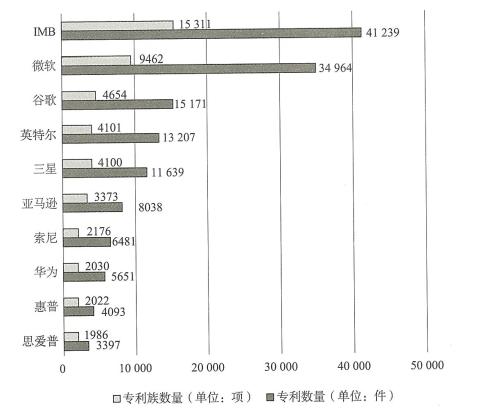
Figure Ranking of Top Ten Cloud Computing Patent Owners in the World (as of 2018)
Taking the communications industry as an example, Ren Zhengfei, president of Huawei, said in a speech at the 2016 National Science and Technology Innovation Conference that Huawei is "gradually entering the no man's land in this industry, and is in the predicament of no one to lead, no established rules, and no one to follow." ". These sophisticated technologies will then be transformed into rigorous, professional, and high-tech patent application documents, which also brings considerable challenges to translators.
The advancement of technology brings difficulty in technical understanding, and also places high demands on the professionalism of patent translators. Therefore, in the patent translation industry, the vast majority of translators, like patent attorneys, have technical backgrounds in science and engineering, and need to continuously accumulate experience in specific technical fields, learn independently, study each document in depth, and expand their knowledge system and become a professional technician in this field. It will be a disaster for any specific patent application document if the translator does not seek deep understanding and perfunctory.
(2) Strict literal translation
For patent documents with legal significance, the translation must be a strict mapping of the source language, any addition, deletion, exaggeration, etc. may lead to the addition, reduction or distortion of certain technical features; especially in some international patents Under the framework of laws and regulations, the inconsistency between the translation and the original text may even lead to the failure of the right of priority.
In this regard, compared with "transcreation" in the translation of other documents that needs to reflect the richness and beauty of the language, in the translation of patent documents, "literal translation" is the first priority to ensure accuracy.
Do strict literal translation, including the following aspects.
1. Copy the special format as it is
The content of patent documents involves specific technical fields, so it often involves language features unique to each technical field, such as subscripts and dashes in chemical formulas, mathematical symbols and brackets in mathematical formulas, italics in Latin names, etc. In addition, special formats such as underline, bold, and italic are often used in the text of patent documents to highlight subtitles or topics. These formats should be presented as they are in the translation process so as not to change the implied meaning of the original text.
2. No addition or omission of content
Any words and phrases related to the content of the article need to be presented as they are, and translations cannot be added or omitted. Even trivial words such as "may", "for example", "so" and "then" should be consistent with the original text whether they appear or not. Numerals used in patent documents, whether numerical, serial numbers, or reference signs providing an index to the content in the drawings, shall be reproduced as such.
3. The translation of the same term or expression should be consistent
Once the same terms or even expressions used in the original text are confirmed to refer to the same technical features, they should be expressed in the same way in the translation. Inconsistent expressions will cause the translation to read incoherently and lose the relevance of the context. In severe cases, the logical relationship of the technical solution will be confused, ambiguous or even contradictory.
For example, the comment in a certain office action is: "The 'pressure reducing valve' is defined in claim X, and the 'valve' is defined in claim X+n, since the 'valve' is defined in claim X+ n never appears in the cited claims, so 'said' lacks a reference basis, and it is not clear whether 'valve' and 'the valve' refer to the same feature". At first glance, it may be thought that the use of the definite article is wrong. In fact, if you look at the original text, you can find that "reduced-pressure valve" corresponds to "reduced-pressure valve", and "the valve" corresponds to "said valve". In the original English text The use of "said" is based on citations, because "valve" has appeared before. The problem is that in the translation process, different Chinese translations of "valve" and "valve" were used for "valve". The "terminology inconsistency" problem that is easy to appear in .
4. Different terms distinguish translation
Similar to the previous point, the same terms should be translated consistently, and different terms should be translated differently. If different terms are translated into the same translation, the logic of the technical solution will be unclear. For example, in the original text "a display device comprises a means for displaying", both "device" and "means" can be translated as "device" under normal circumstances, but if both are translated as "device" at this time, the translation of this sentence That is, "a display device includes a display device", which is incomprehensible. Only by always adhering to this principle in the process of translating patent documents can the translator be sensitive to the appearance of such logically confusing sentences and avoid such problems.
(3) The expression is accurate
In order to achieve precise technical meaning, in addition to fully understanding the technical solution through research and learning of technical content, the expression of translation is also an important aspect. In many cases, the translator is a professional in a certain field and has a good understanding of the original text, but ignores the true meaning of the translation provided by him. This is also a requirement for the translator to have the ability to deal with language pairs. important reason.
The accurate expression mainly involves the following three aspects.
1. The translation is smooth and meaningful
When constantly emphasizing the importance of technical legal knowledge and technical understanding to patent translators, the translator tends to focus all his attention on how to understand the technical solution, whether words are added or omitted, and whether the terms are correct, while ignoring the importance of the translation. What. Therefore, when translating patent documents, in order to take into account the various norms and requirements to be followed, and to ensure that the correct technical understanding is expressed in the correct translation, it is generally recommended that translators read through their own translation completely. The understood translation is undoubtedly wrong.
2. Terminology accurately reflects the scope of protection
When translating patent documents, translators should choose terms in context and express the scope of protection of the technical solution as broadly as possible, rather than simply copying reference translations from bilingual dictionaries or choosing terms arbitrarily according to common sense in the field. For example, "vehicle" does refer to a vehicle in most cases, and even in the drawings of some patent application documents, the vehicle is often used as an example to describe "vehicle", but when the term definition "The term 'vehicle" appears in the context ' as used here may include but not limited to cars, trucks, motorcycles, buses, trains, ships, airplanes, space crafts, and the like", "vehicle" has its wider interpretation, covering both land and water , all means of transportation or vehicles in the air, translating "vehicle" in this document into "vehicle" obviously greatly narrows the scope of protection of the original text.
3. The choice of words is rigorous and unambiguous
To give a few very simple examples: "fill" means "filling", if it is translated as "full", it limits the range; "vertical" generally means "vertical", which is perpendicular to the ground plane by default, and if there is no clear reference In the case of the object, it may be translated as "vertical", which may lead to unclear meaning of the sentence, which does not comply with the provisions of Article 26, Paragraph 4 of the "Patent Law".
3. Language expression specification
First of all, patent documents are objective statements of inventions and creations, and are essentially technical documents. Therefore, the use of language is relatively standardized and concise, without too many complicated tenses and voices, and not too many colloquial and lyrical expressions. Express. Secondly, the technical advancement of patent documents determines that its terminology and sentence patterns are slightly different from other literary works, and some grammars unique to the patent industry have emerged in the continuous evolution of the patent system, and even inventors want to accurately express I will customize some terms when I create my own innovative ideas. Finally, the patent document is still a complete technical document, so in terms of the order and logical structure of the writing, it conforms to the writing method of general technical papers, and there are transitions and mutual echoes.
After understanding the language features of patent documents, translation can better match the meaning and style of the original text, and provide standardized expressions that conform to the language style of patents.
(1) Proprietary syntax, conforming to the specification
Taking English as an example, the grammatical difference between the translation of patent documents and everyday language that translators most often feel lies in articles and numerals. Due to the strict requirements for "clarity" in patent documents, a new feature mentioned for the first time must be strictly distinguished from a feature cited again. In English, using indefinite articles to emphasize the new features mentioned for the first time will make some expressions look weird and even do not meet the requirements of English grammar, but when translated from Chinese to English, such expressions are the only ones in English patent documents Authentic English, such as the example sentences "In a first aspect of the present invention, the compound has a molecular weight of 300g/mol and is not soluble in water at a temperature below 100℃" and "As shown in FIGS.1 and 2, the first sidewall 14 has a window 19, a first number of grooves (two example grooves 20, 22 are shown in FIGS.1 and 2), a second number of grooved regions (two example grooved regions 24, 26 are shown in FIG. 5), the articles and numerals in "a first plurality of flanges, and a second plurality of slots". This will be described in the first part of the fourth section of Chapter VII, so I won't introduce too much here.
(2) Defined words with accurate scope
Section 2.2.7 of Chapter 2 of Part Two of the "Guidelines for Patent Examination" stipulates as follows: "The description shall use the technical terms in the technical field to which the invention or utility model belongs. For natural science terms, if the state has regulations, the uniform terms shall be used. Terminology, if there is no national regulation, you can use the customary terms in the technical field, you can also use little-known or newly emerging scientific and technological terms, or directly use foreign words (Chinese transliteration or free translation), but its meaning has no effect on the technology in the technical field. It must be clear to the personnel and will not cause misunderstanding; if necessary, self-defined words can be used, and in this case, clear definitions or explanations should be given.” This provision refers to the use of self-defined words in application documents Provides a legal basis.
Self-defined words refer to terms created by oneself when new materials or new technical means that have not yet appeared in the prior art are proposed. They have no common meaning in the field and are usually distinguishing technical features of application documents. When encountering self-defined words in translation, we must first understand the original meaning in combination with the context, and then choose a translation that is as close as possible to the original word in terms of coverage to express it.
(3) Clear meaning and concise language
The purpose of patent translation is to present world-wide advanced technologies in the language of local readers. Therefore, everything from translation expressions to punctuation marks must conform to the expression habits of target language readers. The blunt and obscure sentence structure not only increases the difficulty for readers to understand the concept of the invention, but also may have lost some information conveyed by the original text.
On the basis of simple literal translation, pursuing the logic and conciseness of the target language can greatly improve the accuracy of expression, as shown in the following example.
[Example] The light weight of the cursor can be attracted by a smaller magnetic steel, the magnetic force is reduced, and the friction force is reduced accordingly, and the measurement accuracy is improved when the friction force is reduced.
【原译】The Vernier is light in weight and can be sucked with a small magnetic steel. The magnetic force is reduced. Correspondingly, the friction is reduced, the friction is reduced, and the measurement accuracy is improved.
【改译】A smaller magnetic steel member can be used to attract a lighter moving indicator, and a smaller magnetic force accordingly leads to a reduced friction force, which in turn allows the measurement accuracy to be improved.
(4) Fixed clichés, idiomatic expressions
There are inherent sentences or paragraphs between the various parts of the patent document. At the same time, due to the various requirements of patent-related laws on the content of the application document, different parts of the patent document have their own regular paragraphs, such as the term definition paragraph and the scope of protection. paragraphs etc. These sentence patterns or paragraphs are commonly known as "formulas" in the patent translation industry, and the authenticity of the translation of the formulas is also a great manifestation of the translator's professionalism.
100 Fen Translation Company has a strict translation and quality control process, as well as a professional team with intellectual property knowledge, technical knowledge in related fields, and language pairing capabilities, to ensure the provision of high-quality patent document translation services.


